Note

Most of my posts are subject to editing-- I welcome any constructive criticism you have to offer. I'm also open to any changes in the layout, including the background image, as I'm using an unedited template.

I do not cite most of my sources because I feel like it's more or less a waste of time, considering my target audience. If you don't believe me about something, Google it, and if that's not sufficient, let me know.

Pseudo-TL;DR typeface key: major points, takeaways, and general emphasis.

Saturday, October 22, 2011

P90X

Chances are, you've heard of P90X, the most popular DVD workout program ever produced. It's commonly featured in late-night infomercials, and knowledge of it has spread to many by word of mouth. As the name implies, it's a 90-day program designed to whip you into shape, and it works. It was produced by a company called Beachbody and it is led by none other than Tony Horton.

Tony Horton. Richard Simmons, eat your heart out.

P90X is not for everyone, though-- those who are too out of shape will find that they won't be able to keep up. For these people, P90, the less-extreme predecessor of P90X, would be a better choice, along with several other programs that Beachbody has to offer. For extremely out of shape people, you can never go wrong with the classic tried-and-true weight-loss program: diet and walking (or even jogging).


The Right Stuff

Tony Horton is extremely encouraging and does not fail to motivate you. He's ridiculously full of energy and gets you excited about the program, especially from the start. That builds momentum and makes it easier to stick to the program even if the workouts are not easy. Somehow, Tony manages to make those as fun and entertaining as theoretically possible while still kicking your butt. He nudges you out of your comfort zone without you realizing it a lot of the time.

 Tony is very spontaneous. 

The difficulty level seems to be just about right. Most workouts are intense enough to be productive and efficient, but the nature and pace of the workouts makes them very flexible and allows the user to adapt according to his/her own skill level. What do I mean by that, exactly? Time management.

As far as the regular resistance-based workouts go, a lot of the exercises are done on a time basis. You do what you can, and often there's time left over for you to catch your breath before the next movement. This works great because those who are in not-so-good shape are weaker, thereby finishing sooner because they cannot do as many reps, allowing them more time to rest. When an exercise is based on the 8-12 rep scheme, it still works well for the newbies because less resistance or weight means a smaller cardiovascular demand.

The program goes with you; once you get over that initial adaptation phase, each workout pretty much has its own difficulty level that stays constant. The ability to do more reps or more weight puts a greater cardiovascular demand on you, so you progress with the program and it doesn't get much easier or harder.

 Eventually, you too can master levitation.

This goes for the hardest video, Plyo X, as well. Tony puts emphasis on pressing pause and taking a break if you need it on all the videos, but this advice is especially pertinent for this one. The plyometic workout is hard. It never gets easy. It pushes your limits. Tony Horton recommends a heart rate monitor. When I'm in the middle of a cycle and not taking a break (There were less than 5 times when I got through the whole thing without hitting pause) my heart rate tends to be in the range of 160-180 BPM. The upper limit of 180 and into 190 territory is a ridiculous amount of exertion. I've broken 200 BPM on rare occasions-- that is almost literally maximum effort.
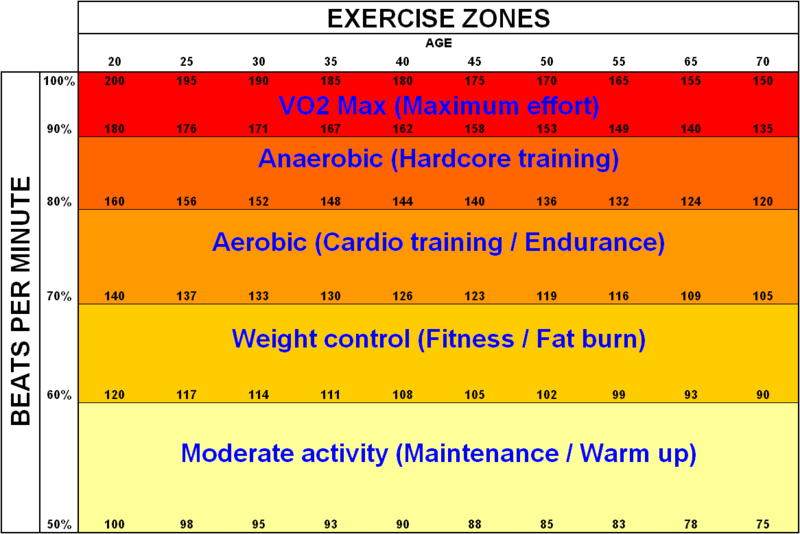
Plyo X: Hardcore training. 
Also, the "weight control" range is BS; it's arbitrarily named.

On difficulty

P90X is tough, especially "the X in P90X," Plyo. However, there comes a point where workout difficulty becomes more self-torture than simply a physical challenge. I am not an advocate of exercise that is this intense. I am not masochistic; I believe that difficulty has a place, but sustainability is much more important. Exercise should not be unenjoyable to the point of suffering.

Very entertaining, but it's really not that bad.

Structure

P90X works very well because it mostly follows the general structure of HIIT (High Intensity Interval Training) and resistance circuit training. These are extremely effective ways to lose body fat, and they also happen to be very good for building muscle on new trainees. This often results in a recomposition of body mass, which is often termed as the "transformation" that is so heavily lauded in the advertisements.

The program has a great amount of variety with over 10 different workouts, some of which are very unique. The 90 days is split into 3 three-week phases with a "rest week" after each phase. However, "rest weeks" are mostly "let's do something different" weeks instead of actually taking it easy during that time.

Not all videos were created equal. Some are easy, some are hard, one in particular is hard in another way: yoga. At an hour and a half long, this workout made me run out of patience after a few weeks, in spite of Tony's assertions that it is worth it. But it is great for developing flexibility and non-traditional strength; it is an aspect of fitness that should be appreciated, though some people take yoga too far and use it as their primary form of exercise, thereby neglecting more important things.

Trust me, this is harder than it looks.

Learning by Doing

There are a lot of educational and psychological benefits to P90X, which are just as good as the physical changes that the program makes, if not better. The program is great for introducing the uninitiated and the directionless into having a solid fitness regimen.
  • The nutrition plan helps to change your perspective on eating and food if you've never followed a real diet before.
  • It pulls you away from the common misconception that "cardio" on a machine or otherwise is all you need to lose weight.
  • It teaches you the correct way to lift weights, and shows women that resistance exercise should not be avoided.
  • It demonstrates that you don't need a gym to get in shape.
  • It emphasizes flexibility, something that is often overlooked.
  • It proves that you can change your body for the better if you want to.
  • It builds character, to some extent
  • It improves discipline and self-control
  • It toughens you up
  • Etc.

The program is great for building mental endurance and toughness. It teaches you how to "bring it"-- to transcend mental blocks and give a serious effort, focusing on the task rather than your comfort. It teaches you how to set a goal and achieve it. And it does all this without being too difficult.

P90X does not require you to be this intense and inspiring.

Words of Wisdom

Sorry for being cliché, but the journey is more important than the destination. The journey never ends; those who reach their goals and fall back to their old ways are defeating the point. I don't like saying "fitness is a way of life" because that sounds a little too serious. Rather, it's more of a hobby. A hobby does not control your life-- it's something you do. If you want to live longer and look and feel better than everyone else your age as you get older, you're going to need to be active. But that doesn't mean you have to do P90X, or try to look like a fitness model. 

Problems with the Program

The nutritional plan is fairly decent. It's outdated and not very flexible, but it works for the most part. It throws around some broscience (workout/gym "bro" + pseudoscience; false assertions made by those who look good but don't necessarily know what they're doing) which is harmless on its own aside from spreading falsehoods and ignorance.

Some of its marketing is misleading, specifically the term "muscle confusion" which is a load of pseudoscientific crap:

 Broscience and steroids. I'm dead serious on the steroids accusation-- the results on this guy were not remotely possible without them.

The program is great for getting into better cardiovascular shape and losing body fat. It is not very good for building muscle, unless the user is fairly new to resistance training. However, it does improve muscle conditioning and endurance, and even strength in certain metrics.

Also, it includes static stretching before certain workouts, which turns out to do nothing but weaken your muscles. Dynamic stretching is much better for warming up, and static stretching should be reserved for afterwards.

While most of the equipment for the program is easily justifiable, for-profit Beachbody tries to make as much money off of you as possible. The "recovery drink" mix is mentioned a lot, and is really not much more than powdered protein and sugar that is ridiculously overpriced. The equipment you do need often costs a good bit more from Beachbody than elsewhere. But I guess that's just capitalism at work.

By the way, P90X 2 is (finally) due out in December. I'm not buying it. Too much equipment, and too expensive. Tony Horton is well into his 50s and still going strong. He really is this generation's Jack LaLanne.

My Experience

My whole story is somewhat long, so I'll try to not start too far back. When I came to college, I stuck with mindset my trainer gave me, but decided all I needed to do to gain muscle was to eat more. In the end, I ate lots, gained minimal muscle, and got fatter. Next semester I decided I needed some serious change and committed to doing P90X. I ate a lot less food and worked hard, and started seeing progress pretty quickly. So without further ado, here are my before and after pictures:

This was actually more than 90 days. 
It's been a while since my "after" picture.

One Last Thing

I leave you with this gem of a parody:

Wednesday, September 28, 2011

Green Eggs and Bacon

I'm sure you're familiar with the classic kids' book:

If your parents didn't read you this book as a kid, they didn't love you. 
They probably would have read this book (NSFW language!) instead.

However, as you have probably guessed, I'm talking about "green" eggs and bacon here in a metaphorical sense. Public opinion would have you believe that these are both fairly bad for you, and you are better off eating a "balanced breakfast" of cereal and fruit juice, and maybe some low-fat sugar-yogurt. This is tied to the whole "fat phobia" but also the "cholesterol phobia."

I recently talked about the ignorance surrounding fat, but as for cholesterol, I'm not going into great detail because Fat Head (and the supplementary lectures) cover it adequately. Long story short, the important thing is this: dietary cholesterol intake has an insignificant impact on blood cholesterol, and total cholesterol levels are bad indicators of cardiovascular health anyway.

The Incredible Edible Egg

Chicken eggs are the classic breakfast food staple. They're pretty awesome when you think about them-- you can mass produce them without directly killing anything (Ohai, ovo-vegetarians!) and are cheap (I tried really hard to not make a pun right there), they are [relatively] durable and seemingly never go bad, and they are one of the most nutrient-dense foods ever. Vitamins, minerals, and tons of micronutrients like choline, on top of 6 grams of protein a pop, make them really good for you on top of leaving you satiated. After all, it's everything a chick needs to develop to the point of breaking out of its own shell. Oh, and if you haven't realized it, an egg is one giant cell. How cool is that?

 Om nom nom nom nom

One of the worst offenses that the health fitness industry has committed against mankind is to spread the idea that yolks are bad for you, to the point of throwing them away so all you have is the egg whites left. The yolk is the best part, and to toss it is idiotic. There's a saying that goes something like this: "Mother Nature cries every time a yolk hits the wastebasket." If you want so badly to eat only the whites, go buy a carton of them at the store instead of whole eggs. That way the yolks don't go to waste and it's easier on you, since you don't have to strain out the whites.

Eggs are good for weight loss, and the calories (yolk-inclusive) are very much worth it. If one wants to cut calories, they should do so elsewhere.

Bacon (AKA meat candy)

Did you know that cooked bacon has roughly the same amount of fat (of which only 1/3 is saturated, by the way, if that even matters) and protein in it? That's probably a lot better than what you were led to believe. Bear in mind that cooked bacon is very different from raw bacon in terms of fat. It's a good, solid meat that's much better for you than sausage (although that tastes good too; I'm a sucker for bratwurst). Plus, it's delicious.

 Remember this viral video? He was right all along!

It also turns out that turkey "bacon" is not better or worse for you, so you might as well eat the non-kosher stuff.
I love real bacon, but not as much as Ron Swanson:


And of course I have to mention EpicMealTime. To not do so when speaking of bacon would be a sin.

Bacon + Eggs = Win

"Bacon and eggs." It's like one unit. The archetypical epic breakfast combo:

More Parks and Recreation. This is obviously a good show.

And again, EpicMealTime, with a side of Tourette's Guy. Oh, and this song.

Drawbacks

Since they are loved so much, bacon and eggs have to be mass-produced to keep up with demand. With that comes less-than-ideal products. Not to worry though, because they can be dealt with.

Bacon is usually cured with nitrates or nitrites. I don't know much about this, though, so here's a nice scholarly article if you're so inclined to read it. From what I gathered from this and other research is this: don't worry about it if you don't eat tons of bacon at once. If you do, it would benefit you to ingest some vitamin C (e.g., orange juice-- it just so happens to go perfectly with breakfast) or other antioxidants (I try to take some green tea extract every day. It's really good stuff.) to offset any possible bad effects of nitrites/nitrates.

It comes down to personal choice. I've eaten this exact kind before.
It tastes the same as cured bacon.

As for eggs, they are generally fine, but it should come as no surprise to you that the standard, inexpensive variety come from hens that spend most of their lives in a tiny cage in dreadful conditions. They are fed low-quality grains, which are probably infused with antibiotics and other great stuff. But that doesn't make the eggs bad, just sub-optimal.

Eh, it's not like they have feelings.
They're better off than the wee little piggies anyway.
Freakin' watermarks.

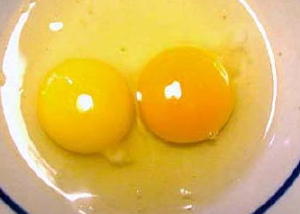
If you want optimal, buy the organic/free range eggs. Now, I'm not on the organic bandwagon (I actually buy the huge 36-egg value carton of regular eggs because I'm a college student) but if you're serious about putting only the best stuff into your body, buy the good stuff, because there is a difference: organic egg shells aren't all white, and their yolks are orange.

Not a huge difference, but it's obvious. 
Presumably, more color = more nutrients.

Not all "cage-free" eggs are produced quite like this, though.

So now you know almost everything you could possibly want to about bacon and eggs. Don't avoid them; they're good for you, despite what many would like you to believe.

Tuesday, September 20, 2011

Silliness, Ignorance, and Gullibility

This post is more or less an amalgamation of many different things that I find annoying, unfortunate, and (sometimes) entertaining.

Common Grammatical Errors

Lose vs. loose:
If you lose a lot of weight, your pants will become loose.

Workout vs. work out:
'Workout' is a noun, and 'work out' is a verb.
I'm going to work out at the gym this evening, even though I'm still sore from Monday's workout.

Regimen vs. regiment vs. regime:
'Regimen' is an exercise plan. 'Regiment' is an infantry division in the military. 'Regime' is a government in power.
The new regime drafted many men into a regiment and put them through a very strenuous training regimen.

BMI

The Body Mass Index is probably the most abused thing in the realm of health and fitness.
The BMI is a population statistics tool, and NOT to be used by individuals to determine healthiness.
It is USELESS as an individual tool because it does not differentiate between lean and fatty weight. There are many body types that make it pointless for use by individuals, such as being "skinny-fat" or being big and muscular. These variations in type tend to cancel each other out, statistically speaking.

BMI is a silly thing that receives an inordinate amount of attention. Ignore what anyone else has to say about it. The most useful tool for determining body type is a mirror.

Ignorant Training Misconceptions

This is the kind of stuff that intersects with some of my other blog posts.

First and foremost is the idea that cardio counts as a full workout and is all you need to do at the gym. Women and people trying to lose weight are the most frequent perpetrators. I'm not going into detail because I've talked about this before, but it is almost always impossible to achieve your ideal body without resistance training.

Intrinsically related to this concept of not lifting weights is the stupid conception that resistance training will automatically make you big and 'bulky.' This is ridiculous. You can never accidentally get too muscular. Even people who try hard to build muscle have a hard time doing so. This is especially true for women, who have nowhere near as much testosterone as men do, which is a powerful anabolic hormone. Women bodybuilders of the grotesque kind invariably take steroids, without which it would be impossible to look the way they do.

By the way, bodybuilding is not so one-dimensional. There are actually 3 major categories in which women compete: full-on bodybuilding (AKA gross), figure, and bikini. The latter usually consists of what women commonly perceive to be the 'perfect body,' but, to be fair, most of them have breast implants.

 And this is why women should lift weights.

But just lifting weights isn't enough. You have to do it right, and a lot of people mess even that up. It's not as simple as picking things up and putting them down.

The most widespread training error is using weights that are too light. This accomplishes nothing but wasting time and burning a nominal amount of energy. Often it's under the pretense of "toning." As I've said before, "toning" exercises are not a real thing. You can develop muscle, or you can lose fat (all over your body, that is; spot reduction is not a real thing either) but you generally can't do both simultaneously. Either way, lifting light weights is ineffective for improving your body because it sucks as a weight-loss method too. You can probably burn calories faster by floundering around in a wading pool with a water aerobics class for senior citizens.

Thank God they're not wearing bikinis.

On the other end of the spectrum are the guys who use too much weight. It's extremely easy to spot this mistake because too much weight almost always causes bad form. It's usually counterproductive too, because bad form usually means poor Range of Motion (which means poor exercise quality), and it also means a higher risk of injury. Plus, it makes you look like an idiot.

Aside from lifting too light or too heavy, there's the problem of lifting wrong.
What I mean by this is an overemphasis on machines relative to free weights, and an overemphasis on isolation exercises relative to compound exercises.

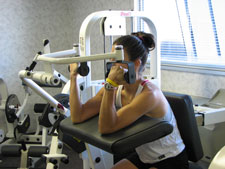
Free weights are vastly superior to machines, with a handful of exceptions. In general, machines force your body to do unnatural and artificial movements, and free weight exercises allow your body to move according to its own physiology. Machines also fail to work the many small "stabilizer" muscles that are synergists to the bigger muscles. Machines also overpromote isolation exercise.

The bicep curl machine. What a worthless piece of crap.

Too much emphasis on isolation (that is, working one thing at a time: biceps, triceps, abs, etc.) and not enough on compound movements (working many things at once: squats, deadlifts, bench press, overhead press, etc.) often results in an unbalanced physique and real-world weakness. In addition, compound free weights are superior to those used in isolation for development of many "accessory" muscles.

But I'm not just asserting what I've learned vicariously; I experienced the difference between machines and isolation and compound free weights firsthand, but that is a long story that I am saving for later.

Speaking of isolation, I'm going to go back to spot reduction and talk about that in better detail. This is goes hand-and-hand with the idea of toning, which is why I mentioned it earlier.
The most common toning/spot reduction exercises I see women do are crunches, ab machine work, and flopping legs back and forth on the leg adductor and abductor machines. They spend ridiculous amounts of time doing these and give them so much attention.

Yes, those machines.

People think that if you work a muscle a lot (meaning low weight and high reps) that muscle becomes more "toned" and the fat above the muscle being worked is used, in part, as fuel for the movement. This kind of makes sense, but your body just doesn't work that way.

Your body picks where it likes to have fat. The place where your body likes it most is where it is the slowest to come off. Conversely, the place where it likes it the least is the fastest to come off. You can't cherry-pick the areas you want to be lean. The only thing you can do is to lower your total bodyfat percentage.
(addendum: technically speaking, spot reduction does exist, but only in a technical and not a practical sense)

If there were a video that summarized everything not to do which I just talked about, this would be it.
This pisses me off so much. Yeah, being a model is REALLY TOUGH, alright. Those workouts are sooooo hard! Idiocy and good genetics right there. But it's not entirely her fault-- this personal trainer is an IMBECILE. I'll talk about trainers in a future blog post.

As Seen on TV

If you try to recall the first commercial of some bogus fitness product that comes to mind, you'll probably think of these ridiculous ab machines, or maybe the infamous shake weight:

Facepalm. 
By the way, big surprise, "dynamic inertia" is a pseudoscientific term.
(I should know, I'm a mechanical engineering student.)
I liked the parody better anyway.

To people with common sense, it should be obvious that producers hire bodybuilders or models to promote their product. They didn't get ripped from it. Sometimes more 'normal' people are used in testimonials, and their transformations almost never result from the use of one extra product. If something is too good to be true, it probably is.

Speaking of ridiculous ads, there's a rip-off of 5 Hour Energy that has even cheesier commercials. So many things are wrong with this: she's not really sweating, she doesn't appear to be actually working/breathing hard, and she is SWITCHING FROM ONE CARDIO MACHINE TO THE OTHER. DIDN'T I JUST TALK ABOUT THIS!? GAAAAAAAH! POSITIVE FEEDBACK = NEVERENDING CYCLE OF IGNORANCE!

Of course most of these things seen on TV are ridiculous. I mean, have you actually seen anyone use these in real life? Sadly, there are some recent products that are just as ridiculous that have seemed to take off-- namely, toning shoes.

I'm sure you're familiar with those things. You know, the ones with the completely absurd commercials? Yeah, well, people fall for them. Luckily, though, some people have working brains.
I don't know about Skechers, but Reebok paid a hefty price for all that false advertising.

I have nothing to say other than "FAIL!"

These retarded shoes had a predecessor: the Fit Flop. This clip summarizes why either of them don't work. If you want a good butt and legs, you need to do squats and deadlifts.

Pretty depressing, right? Well, these things don't hold a candle to the Power Balance wristband.


This makes me so livid that I'm going to have to bust out the CAPS LOCK (AGAIN):

YOU HAVE TO BE A SPECIAL KIND OF STUPID TO SINCERELY BELIEVE THAT HAVING A PLASTIC BRACELET WITH A SHINY STICKER ON IT IS ACTUALLY GOING TO DO SOMETHING!


But you know what? I'm not mad at the creators of the Power Balance band. In fact, I envy them. They got filthy stinkin' rich off of American stupidity. Capitalism at its finest.

And then there is CieAura, Power Balance's inbred cousin, which skips the plastic and involves putting a shiny sticker right on your skin:

WARNING: May make you lose faith in humanity. Watch at your own risk.
"Put one on your forehead and you'll turn into Dr. Manhattan!"

To finish, I might as well mention the one infomercialized product that is actually worth it: the famous P90X. I'll do a post on P90X soon.

Not pictured: The Free Version

Monday, September 12, 2011

Fat Phobia

If you've seen Fat Head, you have an idea why fats have been demonized for the most part. But it's really gotten out of hand, and now advertising has ensured that this cycle of ignorance is going to continue for a very long time. Every other food commercial you see on TV emphasizes that the product has a low amount of fat, if any. Often foods are listed as X calories and Y grams of fat, as if they are independent quantities. I'm really sick of it. Here's a clip of people with bad accents talking about it briefly.

 Fat Free does not necessarily mean "better." Yoplait adds tons of sugar to compensate for the lack of taste. Yogurt is good, but not this crap. Eat Greek yogurt instead: the low- and non-fat versions don't add any sugar and as a result are chock full of protein.

This Seinfeld clip sums up the worst of the ignorance surrounding dietary fat in a satirical fashion.

Recalling Fat Head again, fats are almost the exact opposite of what public opinion would have you believe: they're good for you, even saturated fat. Yes, really.

One kind of fat stands out as being especially good: coconut oil. It's actually a kind of saturated fat, but it's a "medium chain" fat which has some 'magical' properties. Here are two videos on the topic.

But of course there are some bad fats. The processed kinds you don't find in nature.

First, I present to you canola oil. Now this oil just drips with irony (I apologize for that horrible pun). It's touted as one of the "healthiest" oils, but it's chemically derived. And... well, see for yourself:


And then there are the oh-so vilified trans fats. Now, believe it or not, not all kinds of trans fat are as evil as Hitler. But one kind is incredibly bad for you: hydrogenated oil. It's surprisingly common in some processed foods. Try not to eat that at all, if you can help it.

Now here comes the rage-inducing part: FDA rules say that nutritional labels can have rounded-down amounts of whatever is in the food, to the nearest gram. So that means there can be .4 grams in one serving and you can slap a big 'ol shiny sticker on the front that screams "ZERO TRANS FATS!" And that's not all- a 'serving' is a completely arbitrary quantity, and as such it can be exploited. 0.8 grams of trans fats in a serving of a quarter cup? Not a problem, make the serving size half as big and then you can say that there is 0g of trans fats in your product.

Peanut butter is one of the most flagrant abusers of this rule. When you get peanut butter, look at the ingredient list. Don't buy it if hydrogenated oil of any kind is in there. Look instead for "natural" peanut butter. This is the good stuff without the hydrogenated trans fats. 

 See the yellow sticker? No trans fat, my ass!

Hydrogenated oils prevent the natural peanut oil from separating from the rest of the peanut butter, sparing you from having to stir it all the time. This would be nice if it didn't do evil things to your body. There are natural peanut butters, however, that have non-hydrogenated oils added that prevent the oil from separating-- in that case, it's usually palm oil.

Relevant: Tourette's Guy (NSFW language and hilarity)

I don't think I did a good enough job of attacking the stupid cultural phobia of fat, so I might come back to this later. But the take-away lesson is this: calories are what matter most; for yogurt, go Greek; for peanut butter, go natural.

Oh, and avoid skim milk.

Thursday, August 4, 2011

The 80/20 Rule

A really good thing to keep in mind for is the Pareto principle, or the 80/20 rule. It states that 80% of the effects (results) comes from 20% of the causes. 80% profit comes from 20% of the customers. Or, more importantly, 80% of your results comes from 20% of your actions.


What does this mean, exactly? Focus on the fundamentals, not the hundreds of little things that too many people focus on.

20% of what you do, 80% results:
  • Having a good, consistent exercise regimen
  • Keeping track of your average daily caloric intake
  • Eating enough protein
  • Drinking enough water
  • Not being deficient in any vitamins/minerals
  • Getting enough rest/sleep
80% of what you do, 20% results:
  • The difference between 8 and 12 reps per set
  • The difference between 3 and 5 sets
  • Your relative protein, fat, and carb intake
  • Wheat vs. white bread
  • Whole versus nasty skim milk
  • Not eating junk food at all
  • Strictly following your diet to the letter
  • Eating anything deemed healthful instead of something else with the same caloric content
  • Working out so hard you get nauseous or puke
  • Having workouts so hard to the point of being unenjoyable
  • Going way past your comfort zone
  • Going the extra mile
  • Working out on an empty stomach
  • Paying too much attention to your protein intake
  • Drinking a protein shake instead of solid food after working out
  • Worrying about pre- and post-workout nutrition
  • Drinking water or tea instead of diet soda
  • Getting the "low fat" version of anything
  • Having workouts that are unnecessarily long
  • Worrying about high fructose corn syrup or sugar or preservatives, etc.
  • Obsessively reading the nutritional info on everything
  • Worrying about the nutritional facts of food you eat at a restaurant
  • Making sure your caloric intake is always within 100 calories of your goal
  • Not having cheat days
You get the idea. Stick to the basics.

Wednesday, August 3, 2011

On Weightlifting

Overview

As discussed in my previous post, I think anyone wishing to get in better shape should lift weights. Of course there are exceptions for those with bone and joint issues, but I'm talking about otherwise healthy people.

Resistance training is great, but people will have their individual goals in mind when doing it, and that means training differently. Some train for muscular endurance for athletic performance (think rowers and swimmers); some only want to get strong; some just want to get huge; but most just want to look better without going into any extremes- so that's what I'll talk about in this post.

Aside from goals, how you train depends on your experience and personal preference. There is no one right way to do it. For the inexperienced, it's best to find a friend or a personal trainer to show you the ropes before trying anything on your own. Once you are familiar with the gym and most of the exercises, you can either follow a certain program or stick with a trainer. A big mistake most trainees make is not adhering to any coherent regimen, and doing whatever they feel is 'right' (by the way, it's regimen, not regime, which means a government in power). I have been guilty of doing this. Find a program that fits your agenda or mix-and-match. The important thing is to be consistent and to push for steady progress toward your goal.

Guidelines
"Everybody want to look like a bodybuilder but nobody want to lift no heavy-ass weight" -Ronnie Coleman

If you want to look good, you must lift heavy.

By heavy I don't mean train with weights that are really heavy. I mean it should be challenging for you, enough to work your muscles hard, but not so heavy that it takes an extraordinary amount of effort to lift the weight. The general rule of thumb is to choose the heaviest weight that is you can lift 8-12 times, with good form. At the end of each set, the last few reps should be hard. Not "I'm going to have an aneurysm" hard, or anything remotely close to that, but requiring a decent amount of effort and focus. For those who would rather place precedence on strength instead of aesthetics, the rep range should be lower, at about 5 reps per set.

Ahnuld and his training buddies didn't screw around.
Lifting heavy is the best way to go because not only are you encouraging muscular development, you are also doing anaerobic exercise, which is effective for losing bodyfat. However, simultaneous muscular growth and fat loss, "recomposition," is hard to pull off if you're not a newbie or you don't have a lot of extra fat tissue.

The whole idea behind resistance training is to make your muscles work relatively close to their maximum capacity, so your body has a reason to make your muscles grow. When you recover with sufficient rest and nutrition, you will be slightly stronger, so you will need to do more work in order to continue growth, bit by bit. This is called progressive overload.

This is the best Google Images could do. Close enough.

The general idea of weight training is this: you work your muscles hard in the gym, close to their maximum capacity, causing microtrauma (microscopic tearing) to your muscular fibers. Good nutrition and sufficient rest will repair these damages, and then some. Thus, you get a tiny bit stronger. This concept is called overcompensation. If you want results, you'll need to do two things: 'damage' your muscles sufficiently (i.e. give your body a reason to make your muscles grow), and eat and rest well. You get results from recovering from lifting heavy, not from the lifting itself.

But of course when you get stronger, you can't just keep using the same weight. You have to use something just a tiny bit heavier whenever you get a tiny bit stronger. This concept is called progressive overload and it is critical to prevent you from stalling and plateauing. Novice lifters can often pull off linear progression, meaning that you are steadily getting stronger every time.

Okay, so now you know why you need to lift heavy. But what about the kinds of exercises you should be doing?


No, not that Heavy.

Simple, compound movements. Compound means it uses many muscle groups at once, in contrast to isolation, which means only one or a few muscles at a time. Compound is king for improving body composition.

Of the compound exercises, barbell movements are extremely good for trainees of all levels. They recruit many muscles at once- the major ones are squats, deadlifts, bench press, overhead press (often called the "military press"), and rows. Calisthenics (body-weight exercises) are also very important: push-ups, pull-ups, chin-ups, dips, etc.

Here is a great resource for almost every well-known free weight movement out there.

Free weights (barbells and dumbbells, collectively) and calisthenics are also vastly superior to most machines. There are a few good machines out there but there's no need for beginners to use them.

It is a good idea to eschew weight machines when possible. Some are good, but most are bad. I may go into detail about this in the future, but in the mean time do not use the smith machine if you can help it, with the exception of simply using it as a fixed bar to do pull ups or some other calisthenic exercise. As for lifting weights, the biggest drawback the smith machine provides is a false sense of security that can lead to some pretty bad injuries.


Starting Strength


A very good beginner's strength program, lauded by many as the definitive novice strength program, is Starting Strength. It's named after the book in which it is found that you can also find online (I bought a hard copy from Amazon, and it's totally worth it), and it's chock full of great knowledge for the beginner weightlifter. It's an indispensable resource for learning how to do a lot of the basic lifts with good form on your own, and it features some great explanations of kinesiology as well.


On this program, often called 'SS,' one can experience a very rapid increase of strength and muscular development, given everything is done right. Linear progression is to be expected, and it's really quite amazing. Some people get pretty incredible results. It's simple, with two sets of workouts: A and B.
 
There are a few variants for those who want a little flexibility, too. The version I do goes something like this:

A: Squats, Bench Press, Pull-ups
B: Squats, Overhead Press, Deadlifts

For each exercise, you do a few warm-up sets, then 3 "work" sets of 5 reps before moving on to the next one. The work sets should be hard but doable with good form, and there should be several minutes' worth of rest in between sets.

You alternate workouts A and B, with rest days in between, for 3 workouts a week. So, for example, starting on Monday:

A/off/B/off/A/off/off
B/off/A/off/B/off/off

It's simple, but it works. If you get stuck early on, there exists only three possible problems: not lifting right, not eating right, or not sleeping right (8+ hours a night). Skinny guys will need to eat a lot of good, quality food. That means a lot of protein and a lot of calories, every single day.

Rest days exist for recovery; doing squats every other day requires that you eat a lot. But that doesn't mean go nuts with junk food. A common recommendation for very skinny people is to drink a Gallon Of Milk A Day: GOMAD. Yeah, the acronym is fitting. But it works. A gallon of whole milk every day on top of a good bit of solid food will virtually guarantee weight gain for perpetually skinny dudes who can't seem to gain weight ("hardgainers").


For not-skinny novices, especially skinny-fat guys, they can pull off recomposition


Common Mistakes


There are many ways to train right, but there are even more ways to do it wrong.
Unfortunately, people are ill-informed, and many don't know to lift heavy- even some personal trainers are pretty ignorant of this fact (mine was).

When girls lift, they usually use weights that are way too light, under the pretense of 'toning,' which ends up just being a waste of time. Some guys are guilty of doing this, too. There is no such thing as 'toning exercises.' This is an extremely widespread misconception that needs to end. To look toned, one needs two things: muscular development and/or size, and a low bodyfat percentage. And guess what's the easiest way to achieve that? By lifting heavy.

It's very easy to spot people who are lifting weights that are too light: it looks like they aren't even trying. I have no idea why so many people lift like that. If you don't put forth much effort, you can never expect to get good results. But there's another side of this problem: guys obsessed with the amount of weight they are lifting and not caring about bad form. This is an about-face from lifting too light to lifting too heavy. Bad form not only makes you look stupid, but more importantly, it can lead to injuries. If you can't lift a weight with good form, then it is too heavy for you. The biggest exception to this is at the end of a set if you need a little extra something to get the weight up.

At the other end of the spectrum are the guys who just overdo it. Either they get unnaturally muscular to the point of being a freak, or they have an incredibly imbalanced physique. The latter often materializes in the form of 'chicken legs,' but there is a more subtle variety- the guys who are overdeveloped in some areas and underdeveloped in others. What I mean is those guys who walk around with massive arms, but something just doesn't look right. These are commonly referred to as "curl bros." Speaking of curls, they are hands-down the most abused and overemphasized movement ever. The bench press might be in a distant second place.


And then there are the guys who don't ever train the lower half, and this results:

Saturday, May 7, 2011

On Exercise

[This is another post that I'll probably end up updating several times]

Misperception

Exercise, or any kind of physical activity, is too often seen as something arbitrary- something that is totally optional. Some people see it as a mild form of self-torture while others know it's good for them but for a variety of reasons don't do it regularly- usually it's an excuse. Too busy, not enough energy, no motivation, et cetera. Sometimes these excuses are legitimate, but more often than not they are mostly internal justifications. I think one reason really stands out that explains why people fall off the wagon before long: not seeing any substantial improvements.

 I have this on a t-shirt. It's my favorite anachronism.

You're doing it wrong.

Of course nutrition is incredibly important, and that plays a huge part in getting results, but the way in which a lot of people exercise just doesn't work well. The problem is that these people can still be working hard in the gym, and sticking to their routine, but the changes just aren't happening fast enough for all that effort to be worth it.

What am I talking about, exactly? Well, for starters, far too many people go to the gym, get on a cardio machine for anywhere from 30 minutes to an hour, and then leave. Usually it's excruciatingly boring without the row of TVs or your favorite portable electronic device:

Carrot-on-a-stick.

This is incredibly common for women, aptly called "cardio queens." Sometimes they're on a machine when you get there and still there when you leave. And they usually don't have exceptionally good-looking bodies, either. I'll talk about that in a second.

I think traditional cardio (including outdoor jogging, biking, etc) can be extremely beneficial, but to a point. Getting in relatively good cardiovascular shape is very good for your well-being.

Starting to run will do wonders for you. 
However, after a month or two of running, you'll get diminishing returns.

"Okay, what's the 'but'?"
Regular cardio has one major problem with it: it's aerobic exercise. First, a science lesson:

Aerobic and anaerobic metabolism

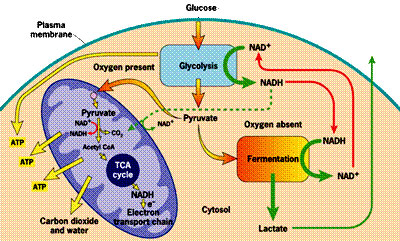
Aerobic means 'requiring air.' Your body metabolizes energy with the use of oxygen, and that's your body's default mode. You can sustain aerobic exercise indefinitely. However, it has a fairly low capacity, meaning that it's not sufficient if you require your body to expend energy really fast- that's where anaerobic metabolism kicks in.
 
Anaerobic exercise uses glucose and glycogen in lieu of oxygen, but in doing so it builds up lactic acid. Now, lactic acid (AKA lactate, half of a glucose molecule) is not the stuff that makes your muscles 'burn,' or the stuff that causes muscle soreness (which is poorly understood, by the way). It's the byproduct of anaerobic metabolism, and when it accumulates, your muscles have trouble working like they should- that's why anaerobic exercise isn't sustainable for very long. To get rid of lactic acid, your body metabolizes it aerobically. Aerobic and anaerobic metabolism therefore work together- the aerobic metabolism helps to remove lactic acid, but at a rate slower than it is being produced. This is why you can run longer than you can sprint, and why you breathe so hard afterward.

This is an oversimplification, though, and this article will provide a better explanation if you are curious enough.

Yay biology!

So, science out of the way, on to my main point:

Aerobic versus anaerobic exercise

 Too much emphasis is put on aerobic exercise, AKA cardio, and it's counterproductive when it's overdone. I think this page talks about the downsides of prolonged aerobic activity pretty well, even if it carries an extremely negative overtone, so take that with a grain of salt.

Of course aerobic activity is good for you if you don't overdo it, but I believe it's inferior to anaerobic exercise if you want to look like a Greek god or goddess. That means improving your body composition, not just achieving a low bodyfat percentage. The point of looking good is not to be skinny- you need muscle, too, females included. Anaerobic activity can get you lean like aerobic activity can, but anaerobic exercise tends to build muscle, while aerobic exercise tends to break it down.

Recall that anaerobic exercise burns calories a lot faster than aerobic exercise. So that's reason #1 why it's superior: you can burn more calories in less time. In addition, you won't be bored because you're focused, and since your muscles are working hard to keep you moving so fast, they won't atrophy like you see on endurance athletes. That's two for the price of one: losing fat and maintaining (probably even gaining) muscle! And not only does more muscle look good, but it also burns more calories- that's a bonus!

But wait, there's more!

Anaerobic exercise will keep burning calories hours after you finish- it's called 'afterburn:'
"In a 1992 Purdue study, results showed that high intensity, anaerobic type exercise resulted in a significantly greater magnitude of EPOC than aerobic exercise of equal work output."

That's right. You can burn the same amount of calories in less time with anaerobic exercise, but you get a bonus on top of that. And that is why I don't do traditional cardio- it's long, it's boring, and it's less efficient. But, remember, aerobic cardio is still good if you don't overdo it. This is just a matter of personal preference.

 These are extreme ends of the spectrum.
Of course the guy on the right weight trains on top of sprinting.

 More marathoners. The one on the right won the race.

Anaerobic exercise comes in two flavors: anaerobic cardio, and anaerobic resistance training.

There are many types of anaerobic cardio: running, sprinting, biking fast, spin class, etc. But there's one variant that stands out: High Intensity Interval Training. It has some amazingly good benefits. One variant is known as the Tabata method, which only lasts for a total of four minutes. Of course, it's incredibly intense (some call it "four minutes in hell": 20 seconds of running at top speed, then 10 seconds of walking, repeated 8 times). It may not sound that bad, but, trust me, it is. I've only done it a few times. I don't recommend it, but I brought it up to make a point: you can get more out of 4 minutes of HIIT than half an hour of cardio.

Resistance training, more commonly called weight training or weightlifting, is for everyone, males and females alike. Of course some people are perfectly happy with the amount of muscle tissue (or lack thereof) they have, but I'm talking in generality.

Why?

The benefits of weightlifting for guys is obvious, but women should do so, too.

As mentioned previously, building more muscle means your body burns more energy at rest, making it easier to lose weight or to stay lean. This is awesome on its own.

A lot of women who do lift weights do so because they want to get 'toned.' And they do so by lifting light weights at high repetitions. This is a waste of time. 'Toning' exercises are almost completely useless apart from burning a few calories. Spot reduction is a myth- doing hundreds of sit-ups or crunches won't get rid of the fat around your belly. Having a toned appearance means having well-developed muscles at a low bodyfat percentage.

Seriously?

To develop muscles, women should not train much differently than guys- they must lift heavy weights. And, no, lifting heavy will not make women 'bulky' like guys. Testosterone is a crucial hormone in building muscle, and women have much less of it than men do. Female bodybuilders (I don't think I need to provide a picture of that) train very hard to look the way they do, and often it's with the use of steroids.

Lifting heavy usually results in the 'toned' appearance for women that they like so much.
There's a fine line between female bodybuilders and fitness models. Take Jamie Eason (spokesperson for Bodybuilding.com) and Kathleen Tesori (who has a 9-5 job), for example.

So as it turns out, weightlifting can get you your ideal body, regardless of gender.

I'll talk more about weightlifting in my next post.