Giving you everything you need to know about nutrition, fitness, and health science, one post at a time.
Note
Most of my posts are subject to editing-- I welcome any constructive criticism you have to offer. I'm also open to any changes in the layout, including the background image, as I'm using an unedited template.
I do not cite most of my sources because I feel like it's more or less a waste of time, considering my target audience. If you don't believe me about something, Google it, and if that's not sufficient, let me know.
Pseudo-TL;DR typeface key: major points,takeaways, and general emphasis.
You may have heard a variation of the quote "Your mind will quit 100 times before your body ever does." To be honest, I don't like this sentiment-- it simply isn't true a lot of the time, but like many absolute statements, that is to be expected.
In reality, for most cases, your body can and will "give up" before your mind does. Exhaustion is a biochemical phenomenon and the strongest neural signals can only do so much. This isn't just limited to things like weightlifting, where muscular failure is fairly easy to attain. When lifting something really heavy, you may only be able to perform one repetition, if any at all, before your muscles reach their limit; not even the combined willpower and tenacity of the 300 Spartans is going to change that.
One of my favorite man flicks. I actually have this poster on my wall.
Continuing with the Greek theme, the Olympics are not just a test of willpower. They are a test of genetics and training. The gold medalist is often the strongest or fastest competitor, no matter how hard someone from Montenegro, who barely even qualified, tries. People are limited by their bodies, but I will cede that willpower does play a large role in how hard one trains for athletic performance, so it does have an indirect impact.
I think I've sufficiently demonstrated my point that your body is more likely to fail before your mind in single instances-- however, there is another side to this quote that is somewhat silly. Take long-distance running, for example. If you're not much of a runner, like me, running is not an enjoyable activity. Sure, it's a lot easier for you to stop running (your mind quitting) than it is to run until you puke or collapse or pass out (or a combination of these; your body quitting), but no sane person would ever want to do that.
Ultimately, I like this thought much better: Don't be afraid to exert yourself and push yourself to your limits, both physical and mental, within reason. Effort and Willpower
There is a lot of psychology behind exercise and athletics, but I want to focus on one thing in particular: effort and willpower, between which I will differentiate.
I believe effort is essentially how hard you are trying at any given moment. You may think of it as a percentage, but I will mention here that it is one of my pet peeves whenever someone says you can 'give it' over 100%. You can't. It's impossible. You cannot do the impossible.
That being said, you'd be surprised how intense 100% actually is. Human experience is extremely subjective and relative, and most people only evaluate things with respect to past experiences. Most people rarely, if ever, give truly maximum effort. Depending on the scenario, putting forth a large degree of effort can be extremely distressful (e.g., running for your life) or extremely invigorating.
I define willpower as the capacity to give a high amount of effort, or give it consistently. You're not going to do anything difficult if you don't want to do it. This applies to a single workout as well as an entire training regimen.
In modern first-world society, we are conditioned to be relatively lazy and sedentary people. Many have become soft and afraid of effort. Willpower is often shallow because people seldom really need to exercise it-- we are not used to working hard for something we want, because it's relatively easy to live by taking the path of least resistance. Willpower is like a muscle, and if you exercise it, it will get stronger. Do not be afraid of effort and do not let the amount of effort required to meet your goals deter you.
Ignore that double negative.
Don't overdo it, of course, but you need to realize that what seems "too hard" is very attainable. It's just all in your head-- many sane people have already done what it takes to go far beyond your own goals. Take it all one step at a time or one set at a time. Don't let yourself believe "this sucks" when exercising or dieting because if you do, you will have a hard time staying on track.
Of course, exercise doesn't have to be something painful. Working out does interesting things to brain chemistry and on top of releasing endorphins to the point where people enjoy working out with intensity (e.g., runner's high), it promotes mental health: happiness, stress relief, and a plethora of other benefits including resistance to mental disease. You'd be hard pressed to find someone in really good shape who doesn't like to exercise. Get excited about actualizing your goals and doing hard things becomes, paradoxically, easy.
When lifting weights, especially if it's something heavy for you, an oft-given piece of advice is to attack the weight. Don't let it scare you. Do not worry about failure and just do whatever you can with good form. If necessary, grit your teeth and grimace. Think about something that really pisses you off and turn that anger into something constructive-- it will make you feel powerful!
I'll leave you with this well known essay, "The Iron", which talks about the mental aspects of lifting.
People, in general, are ignorant, stupid, and gullible. They believe most anything conveyed to them by an authoritative source, and never question the veracity of much of, well, anything. Most people are sheep. So it should come as no surprise that people fall for the stupidest fad diets time and time again-- diets that are founded on the basis of pseudoscience and quackery. These diets, at best, are simply ineffective, and, at worst, detrimental to your health and bank account.
The #1 bad fad diet in recent times is the hCG diet. It's nothing less than a scam. Basically how it works is you diet with a severe caloric deficit (<1000 calories per day) and take ahomeopathicpregnancy hormone (!?) to boot. I'm not going to talk much about it because ranting about the sheer stupidity of this diet has been done before.
Speaking about sheer stupidity, there's this thing called Applied Kinesiology which is almost on par with homeopathy.
It is important to note that a lot of these pseudoscientific things are advocated and sold by chiropractors. It is important to know that chiropractors are not doctors, so don't trust them with anything other than popping your back. In fact, chiropractic practice and pseudoscience are closely tied together, so tread lightly. However, even doctors and other legitimate professionals (nutritionists, trainers, etc.) can promote idiotic stuff. Don't blindly trust professionals who are out of their element.But trust me because I have a built-in science BS detector and I do my research.
Shut up, Donny.
Back to bad diets, there are a few more I want to mention:
Diets consisting of only fruits and/or vegetables (in juice form or not) are stupid. While these are good for you as part of your diet, a severe lack of proteins and fats is not good for you.
The Master Cleanse and any kind of "cleanse" or "detox" is based on pseudoscience.
Long term fasting means malnutrition. You don't want to starve yourself and harm your well-being. However, short term or intermittent fasting is great.
Low fat diets are bad because your body needs fat to make hormones, and eating insufficient amounts of fat does not "force" your body to use its own stored fat.
In general, if a diet requires you to buy any special product and/or is unsustainable in the long term, stay the hell away from it.
I've touched upon this topic before in previous posts, but I felt the need to expand upon it because it's something that is very important. Please excuse the inevitable redundancies.
The problem
The plurality of people I see in the gym operate under the notion that as long as they're doing something, they are using their time to the best extent, and that it doesn't really matter what they do, but rather the fact that they are doing it. It is not unlike the sentiment, "it's the thought that counts." This is foolish and futile.
Not all exercise is equal. There's the too-common phenomenon of people not putting forth enough effort, going through the same motions, and never realizing that they aren't seeing any improvements because they never do what is necessary to make that happen. However, some people do put forth enough effort, but it is misapplied.
Just because an exercise is hard, that doesn't mean it's the best use of your time and energy.
The first thing that comes to mind as an example is sit-ups and countless variants thereof. People like to devote an inordinate portion of their workout to their abdominal muscles (sometimes ONLY working abs), and 9 times out of 10, they never see any appreciable results, and yet, never question why.
There are a few things you should know:
Spot reduction is not a thing. You're not going to directly burn belly fat by working your abs.
You should train your abs just like every other muscle in your body-- a difficult 8-15 rep scheme for a 3 or 4 sets is not a bad plan.
Isometric exercises (e.g. planks) don't accomplish a whole lot more than pain.
You don't need 10 different ab exercises to work them sufficiently. One or two is sufficient, given they are good exercises. You don't do 10 different leg exercises, do you? There is no benefit to redundantly working a muscle in isolation with different movements. There are some exceptions, but almost all of them only apply to bodybuilders. I'd even argue that novices should stay away from almost all isolation exercises, including ab work. There are plenty of compound movements that sufficiently work your abdominal muscles. But if you are working abs in isolation, you ought to be working many other things in isolation, too.
Nice looking muscles (including abs) are accomplished by having a low bodyfat percentage and at least some amount of hypertrophy.
Doing high reps of an isolation exercise is not going to do much for you aesthetically. 20+ is skirting the edge of useful work for hypertrophy; it will hardly matter even if you go to failure if you do many more reps, because higher rep schemes will only improve the endurance of your muscle and will not do much for improving its appearance. "TONING" IS NOT A THING. You can either lose fat or make your muscles bigger; those are the only two options.Nice looking muscles (including abs) are accomplished by having a low bodyfat percentage and at least some amount of hypertrophy; doing a bunch of reps in isolation is not effective at doing either.
If you can do much more than 20 of a given exercise, and/or are able to
do different exercises that work the same muscle group back-to-back with
little rest, you are not doing it right. You're not doing what is
needed for hypertrophy and there are far more efficient ways to burn
calories. This applies to almost everything, but unnecessarily high rep
schemes are the most common in abdominal exercises.
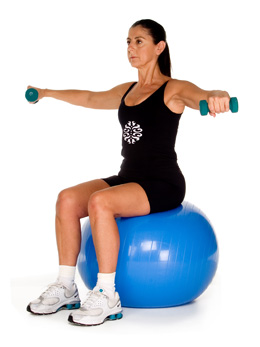
Stay away from the swiss balls, and stay away from the crunches. They accomplish almost nothing, unless your abs are really, really weak.
Some alternatives
While ab exercises are pretty bad for those who want to lose fat, there are a few compound exercises (not ab-centric) in particular that, if you don't screw around, high reps can end up doing you some good in terms of fat loss. The more reps you can do, the more calories you can burn. Since you're
working a lot of muscles simultaneously, energy expenditure can really add up fast.
One of the most well-known exercises for this purpose is the pushup. The pushup is a compound bodyweight (calisthenic) exercise that uses a bunch of muscles (including your abs; it's like a moving plank) simultaneously. It doesn't just work the chest muscles. Every person in good shape should be able to do at least 20 of them. If you're interested in getting to be able to do a bunch of pushups at a time, check out DailyDrill.
However, I can't talk about the pushup without mentioning its evil relative, the burpee. The burpee is one of the most intense anaerobic exercises out there that doesn't involve running; few things burn calories as quickly from just your body weight. All it is is a pushup followed by standing up and jumping in repetition, but it is much easier said than done to do something like 20 of them. It uses almost every major muscle group in your body while taxing your cardiovascular system; it really works.
There is also the infamous 20-rep squat. It is unlike any other exercise; they are affectionately also known as widowmakers. The name makes sense once you. These are 20 weighted squats, at a weight that is about half of your one-rep max. Since the squat uses the largest muscles in your body, it requires a tremendous amount of energy and willpower to do 20 of them. For most people, the limiting factor is the sheer cardiovascular demand. This exercise is so much more efficient than anything else it's not even funny.
Other notably efficient exercises are running up stairs, sprints (Tabata for the relentless), jumping rope, and pull-ups.
When doing a high-rep exercise, the focus should be on exerting your cardiovascular system rather than just grinding through it and feeling "the burn." When done right, this kind of exercise will be more efficient and effective than even most forms of cardio.
However, it should go without saying that lower repetition, compound resistance exercises are still incredibly important for overall muscular development, which is something that can greatly benefit everyone.
The central issue
To most people who fail to see results from working out, it just boils down to them not really knowing what they are doing, but "exercising" in vain anyway. Some people have put this to a rather harsh, yet accurate, word: fuckarounditis. Read the article and make sure you never fall into that trap. Women are especially susceptible to screwing around in the gym-- I see it all the freaking time. It's the worst on the mats when they do "ab exercises" that just don't work. This does extend into weight training, too, but it is usually confined to flopping around on the weight machines.
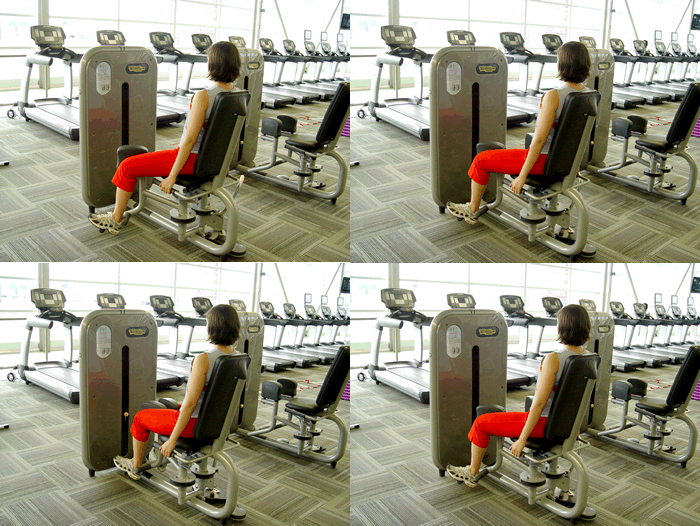
Do yourself a favor and never touch this machine, or its counterpart, and do barbell squats instead.
Here are some of the major pitfalls of people's exercise habits:
Workouts and/or individual exercises are simply not intense or difficult enough
Cardio is overemphasized; some people don't even lift weights
Rep range is too high under the pretense of "toning" and spot reduction
Resistance training is devoid of legitimate effort
Over-reliance on weight machines
Doing too many isolation exercises and not enough compound exercises
Workouts are made up on the fly instead of sticking to a planned regimen or program
Failure to set realistic goals and work to meet them
Failure to recognize a lack of progress or a plateau adapt accordingly
Failure to push one's limits and leave one's comfort zone
Every single thing you do in the gym should leave no doubt in your mind that what you just did will force your body to improve in some way. Don't be intimidated by trying new things, and don't be afraid of effort.
Product marketing has created a self-sustaining cycle of ignorance. Idiotic labeling and equally stupid advertisements are to blame for the majority of public misconceptions about nutrition.
Low fat! Fat free! Low sodium! No trans fats! 0 mg cholesterol! Whole wheat! Whole grains! Multigrain! Low sugar!
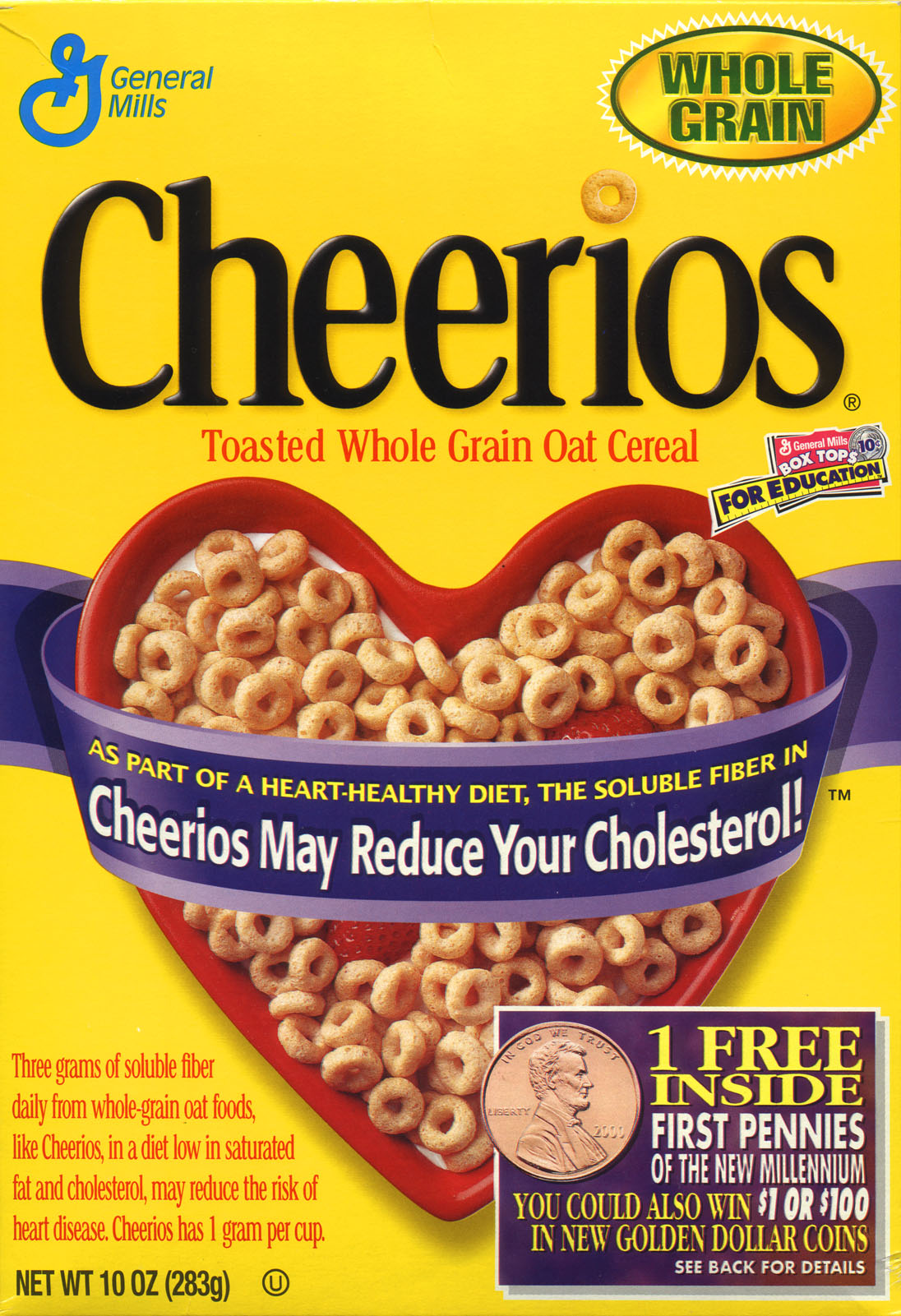
It's all bullshit. Observe one grievous offender, Cheerios:
Read the red text in the corner. Not only are there blatant lies, THERE IS ONLY ONE GRAM OF FIBER PER CUP, AND THAT IS THE BASIS OF THE WHOLE "HEART HEALTHY" BOX DESIGN! WHAT THE HELL!?
All this labeling is usually a load of crap, and it is the metric by which most people judge the "healthiness" of food. There are so many things wrong with food labeling that I'm just going to give you the short bulleted version.
What's wrong with labeling and "nutrition facts":
"Low fat" usually means "high carb" outside the context of meat. Guess which one is worse for you?
Saturated fat is not bad for you, so telling you how much saturated fat is in something on the front label is pointless. In fact, saturated fat is better for you than chemically-derived plant oils, like vegetable oil and canola oil, and any kind of oil that is used in frying (the high heat in deep frying oxidizes fats, especially the less-stable nonsaturated ones; oxidized fat is bad news.)
"Percent" fat-free is a silly claim. Most of the time, fat content is prioritized over caloric content, which is ass-backwards. Likewise, the distinction of "calories from fat" is stupid and should be scrapped.
"Low sugar" is a mostly useless claim, because carbs are still carbs. Whether they are in the form of sugar or not is a mostly-arbitrary distinction. Sugar usually produces a larger insulin response by itself (one major exception is that of vegetable starches, e.g., potatoes, which are technically complex carbs: they happen to have a higher glycemic index than pure sugar). However, in the common presence of fat and protein, all carbohydrates digest much more slowly and therefore have a lower GI than if they were by themselves. For these reasons, a low sugar food can easily have a lower GI than a high-sugar food. Since the impact of sugar is completely context dependent, its presence or lack thereof is nearly irrelevant.What would be superior to listing the amount of sugar in a food is showing the glycemic index (or glycemic load per serving) on the front of the package. This would already be of great benefit to diabetics (who must be cautious of high blood sugar), but it would also make people realize that many "healthy" low sugar foods are really not that good for you. (Note: GI is mostly irrelevant in the short term as far as weight loss/gain goes [as calories are the #1 factor in this time frame], but in the long term it has serious implications regarding metabolic health.)
"Whole grain" MEANS ALMOST NOTHING IN TERMS OF HEALTHFULNESS. So what if it's composed of all parts of the grain? It's still full of mostly empty calories! Did you know that whole wheat bread produces an insulin response virtually identical to that of white bread, which is greater than the insulin response of soda?In fact, most grain products are more or less the same in terms of GI and lack of substantial nutritional value. This is why the food pyramid is retarded.
HAHAHAHAHAHAHAHAHAHAHA. IT'S SO STUPID IT'S FUNNY.
"Grams of whole grain" is about as relevant as saying "grams of bacon." "X grams of whole grain per serving!" doesn't mean anything significant. The amounts of nutrients contained within food are what's important, not the amount of the food itself.
It's better for you, too! (seriously)
"Multigrain" is a virtually superfluous claim.The presence of different types of grains doesn't make it meaningfully better for you. An accurate analogy would be a Suicide from a soda fountain-- mixing different sodas together doesn't make it healthier. In fairness, though, like sodas, different grains have different GIs, so mixing them will do you slightly better than just one that has a higher-than-average GI. Similarly, some grains have a modestly higher fiber and micronutrient content. In the end, the benefit of multigrain is so infinitesimally small as to be negligible.
Please excuse me as I hit Caps Lock and pound furiously on my keyboard: SEB;KVOBJAS;OVDBFDVJIBDSP[HOIFANOIOHISJOIA;GOIBNASD.
You're kidding me, right? Right!?
Minimally processed (or refined) grains are better for you than highly processed ones. Unlike the "whole grain" distinction, it actually makes a difference, yet
"whole grain"is still the go-to for making you feel less guilty about
eating insulinogenic carbs. Less-refined grains, like oats in standard
oatmeal, are better for you in that form compared to cereals made from
oat flour Cough...Cheerios.. Cough. Again, this has to do with insulin response: although
the benefit of a lower-GI food is miniscule on a day-to-day basis, in
the long run it can make a huge difference in terms of metabolic health.
Dietary cholesterol has a miniscule effect on your serum (blood) cholesterol. Therefore, cholesterol content of food doesn't matter.
In fact, carb intake can have a huge impact on your cholesterol, so, ironically, you're
much better off having wholesome eggs for breakfast than
cholesterol-free refined grain cereal.
Protein content is almost never featured on the front of the package, even though protein is the best macronutrient!
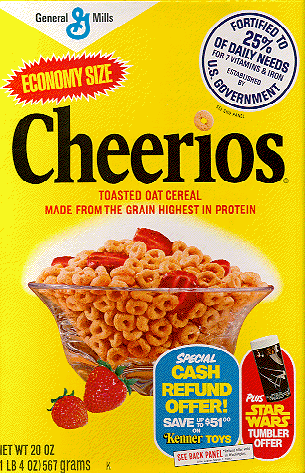
Protein and Star Wars, with no ridiculous claims? Things really were better in the days before retarded dietary recommendations.
Caloric content is rarely displayed on the front of packages, but instead a bunch of irrelevant previously-mentioned catchphrases are. The amount of overall Calories is more important than that of individual nutrients.
Serving sizes are completely arbitrary and are not standardized whatsoever. Nutritional claims are always relative to those arbitrary servings. Sometimes, this is exploited and the stupidity reaches ridiculous levels:
1 g serving size: ARE YOU FREAKING KIDDING ME!? GAAAAAAAAAAAAHHHHHHHHHHHHH! HULK SMASH!
Sodium isn't necessarily bad for you. It doesn't cause cardiovascular problems. What's important is your body's electrolyte balance. Eating a lot of sodium doesn't matter unless you eat much more sodium than other electrolytes like potassium. Otherwise, your kidneys will do their job just fine as long as you drink enough water.
Micronutrients are almost never listed if they're not vitamins or minerals. There are so many salubrious compounds in fruits and vegetables and other foods (phytonutrients, naturally-occurring omega-3 fatty acids, etc.), but there's no way for you to know that they're there. Thankfully, there are some resources that explain why fruits and vegetables are so good for you, and why you should eat them even if you take a multivitamin. The tendency to eat more fruits and vegetables probably one of the few redeeming qualities of vegetarianism.
On the flipside, it's refreshing to see that fruits and vegetables don't have labeling all over them because they're not manufactured by a corporation. Thankfully, you'll ever see apples with FAT FREE LOW SUGAR ZERO CHOLESTEROL LOW SODIUM HIGH FIBER NO PRESERVATIVES LOW CALORIE stickers all over them.
If a food is "a good source" of an added vitamin or mineral, you're probably better off taking those nutrients in the form of a multivitamin.
Sometimes, the claim of no trans-fat is a lie. The FDA allows everything to be rounded off, so something with 0.49 grams of trans fat per arbitrarily sized serving can still claim to have no trans fat, so don't trust the claims. Look at the ingredients list-- hydrogenated oils are trans fats, and you should stay the hell away from anything containing it.
Peanut butter is one of the worst offenders. Buy the "natural" stuff instead. Usually, you can't even tell the difference if palm oil (mostly saturated fat, no less) replaces the evil stuff.
Most of the FDA's Recommended Daily Intake as far as calories and macronutrients (carbs, protein, fat, and their constituents) are concerned are COMPLETELY ARBITRARY WITHOUT ANY LEGITIMATE SCIENTIFIC BASIS WHATSOEVER!Don't take RDI (or its counterpart, % DV) seriously for protein, fats, and carbs and their subcomponents like types of fat and sugar.
Even recommended vitamin and mineral intake is fairly arbitrary, but it at least it is backed by legitimate scientific studies. Recommended amounts are purely ballpark estimates for the "average" person. In many cases it is beneficial to intake several times the recommended daily amount of a nutrient, like vitamin D.
The "standard" 2000 calorie diet is an arbitrary metric as well. It is not a one-size-fits-all recommended intake. There are way too many individual factors to set any number of calories as the status quo.
Keep in mind: the same people that give crappy dietary recommendations also like to use BMI on an individual basis-- i.e., they have no idea what they are talking about. DON'T TAKE ANY STOCK IN WHAT THE FDA OR USDA SAYS AS FAR AS WEIGHT CONTROL GOES!
Sugar alcohols are BS. Net carbs are more important than total carb count; that is, fiber has negligible caloric value and so should not count as "true" carbs even though they are still technically carbohydrates. However, sugar alcohols do count about halfway. The truth of it is that they have a less than 4 Calories per gram, but for some reason, there are a bunch of protein and diet bar manufacturers who put a bunch of sugar alcohols in their products and don't include them in the count towards net carbs. This is essentially lying but it's still legal for them to do so! At best, it's a nuisance, and at worst it can sabotage a ketogenic diet.
I may tack some more points on here if they come to mind later on, but I think this is good enough for now. Hopefully this has been one of my better didactic posts. Now you are no longer a sheep who takes food labeling at face value, and that can be hugely beneficial. Be smarter than the people who design the labeling.
Fitness and healthy living is something that most people want but aren't necessarily willing to work for. And many of those who try find themselves struggling to keep it up after a while. If you want to succeed, you must remember that fitness should be, more or less, indefinitely sustainable. If you're willing to work hard for something, don't you want to keep what you've earned and not retrogress? As much as common sense as that may seem, the reversal of progress happens fairly often to those who find themselves in trying circumstances. I've done it myself many times but I never fail to get back on the horse and drive forward again.
Chinese Proverbs are even better in Courage Wolf form.
Many people encounter difficulty in pursuit of their own goals. When these things happen, one often blames him or herself for being too weak-minded. Usually, temporary failures are taken too gravely, which leads to prematurely giving up-- usually with hollow justifications. "I'm not cut out for this," "I'm just genetically predisposed to look this way," "The effort isn't worth it for the results I'm getting," "It's not worth it anyway," etc. Don't fall for the trap, and keep trying. It will be worth it.
Still, there are several things you can do to prevent yourself from falling off the track, so to speak. Some of these seem like no-brainers, but you'd be surprised how people rarely utilize them.
Think positive
It's easy to become discouraged when you're struggling with your own progress in the gym and you see someone who is about 5 years' worth of work ahead of you, and a little voice inside your head says "I'll never get there." Don't listen to that voice, and don't compare yourself to others. The only important competition that is going on is between you and your past self. It's amazing how far you can get if that is your primary focus.
Sometimes, children's books are incredibly profound.
As Henry Ford said, "Whether you think you can, or you think you can't--you're right."If you're a relatively healthy person, there is nothing keeping you
from looking like a model one day, if you so desire. It's very possible
and it's not as hard as you think. It just takes a lot of time, dedication, and patience.
Use music to your advantage
Music has the potential to make exercise a lot more enjoyable. Of course there's the fact that it helps distract your mind from thinking "man, this sucks." But it can also motivate you or give you a psychological energy boost. It can even alter your brain waves for the better.
Personally, I hate most of the music that plays on the gym intercom. First of all, it's mostly just background noise with pretty bad audio quality, and, secondly, it's usually just overplayed or just plain crappy mainstream music. Do yourself a favor and bring your own audio device with some decent earphones. Music is a lot more helpful when you choose it yourself.
Just don't wear over-the-ear headphones at the gym. They make you look like an idiot.
You can also customize playlists to better tailor them to the type of exercise you are doing. For instance, a running playlist would be very different from a weightlifting playlist. My running playlist is laughably cliche but I've found that it actually helps a lot. It even helps me keep track of my pace if I run the same route every time, and remember where I was the time before when a certain part of a song plays.
Be Smart
It is not the best idea to show up to the gym and make up your own workout unless you are confident that you know what you're doing. Too many people fail because they do the same thing every time and just end up going through the motions. Your body adapts to change; when your workouts stagnate, so will your progress. Simply getting on a cardio machine for half an hour and moving around some weights will not get you the results you seek. You must continually force your body to adapt, and it's easier than you'd think to accomplish that. Find a workout regimen that is compatible with your goals and stick to it.
The only thing this accomplishes is a waste of time.
You should try to push your limits. Leaving your comfort zone is what will get you the fastest results. Try to make a small improvement over what you did last time. Challenge yourself, but don't overdo it. You should never regret a workout once it's over with-- working through pain is not worth it. It is one thing to leave your comfort zone and test your limits; it is another if you feel nauseous, hypoglycemic, or otherwise terrible and you feel the obligation to keep going.
Don't jump headfirst into a program and try too much too soon. Gradually
increase the difficulty of your workouts if you are not in the greatest
shape. This way you won't burn yourself out and condition yourself to
view exercise as a painful and torturous thing. You shouldn't be dead tired a full hour after finishing your workout, either.
If your goal is fat loss, exercise isn't going to do much if your diet still sucks. Track your Calories if possible. Likewise, if your primary goal is to put on muscle, you must eat a caloric surplus, and tracking your food intake is a good idea as well.
Create your own energy if it doesn't come naturally
Often, the main reason people can't keep up a fitness regimen is a simple lack of energy. It seems that a lot of people in very good shape and health have,
unsurprisingly, type A go-get-'em personalities. Of course this seems
like an unfair advantage to most of us normal people, as we don't have
that kind of naturally hyperactive drive and energy, but don't use that as an
excuse. There are plenty of people who don't have a seemingly infinite
supply of energy but still achieve their goals in spite of that. Just
because something won't come as easily to you as it does to others means
you shouldn't pursue it, or that it's out of your reach, or even that it's particularly more difficult.
I've already discussed how important it is for you to get
enough water, nutrition, and sleep in order for you to function well
both mentally and physically, and how stimulants can help dramatically
if you have the desire to exercise but simply don't have the energy or
drive to do so. Some stimulants can even make you temporarily feel like you have that type A personality, and it really is amazing the difference that they can make. Just remember that you're not limited to caffeine-- the market for pre-workout supplements exists for a reason.
I really like this stuff, if you haven't figured that out yet.
When you actually go to the gym, it is a good idea to not do so on an empty stomach. A modest amount of carbs and protein beforehand can make a huge difference in allowing you to sustain energy throughout your workout by having amino acids and glucose readily available for use by your body.
Warming up is important too. It may seem silly to some people, but doing some moderately easy motion for a while to get oxygenated blood flowing and your brain engaged can help immensely.
Sometimes, when you simply feel apathetic or not into it, you just need to pump yourself up. If you're a naturally calm and low-energy person like I am, it's amazing what it can do. Some suggestions: Listen to loud, intense music. Jump around. Take several quick, deep breaths. Slap yourself. Splash some water on your face. Make loud noises. Shake out your hands. Remind yourself of someone you hate, and think violent thoughts. Again, this can make a world of difference. You don't have to be as intense as this guy, but you get the idea:
Likewise, when doing any kind of exercise, especially lifting weights, you must have the right mindset. Do not view it as having to reluctantly do something-- view it as a challenge that you are willing to face head-on with the intention of winning. Dominate the exercise; don't let it dominate you.
Often, exercise in itself will raise your energy levels through the next day or so, making it easier to do your next workout, resulting a sort of momentum effect. Get the ball rolling and it's not so hard to keep it going. Sometimes the energy boost is very noticeable and it can help put you in a good mood and make you an overall happier and more lively person.
Find a partner (if you can help it)
A major reason as to why personal trainers are so prevalent is that working out alone is tougher than with some company, especially when you're learning the ropes. I had a trainer when I was getting started and to be honest I had no idea what I was doing before then. It helped immensely but eventually I outgrew the need for a trainer, who turned out to be not that great at his job anyway.
Trust me, it's not funny if I need to explain the joke.
Whether it's a trainer or a friend, exercising with someone else can honestly make it a lot more enjoyable and a lot less painful. With a friend, it's even better if you are in similar shape; you can make it a competition and it's amazing what that can accomplish. Even if you're at different levels, simply encouraging and challenging one another can be very helpful.
Let your progress and goals drive you
Of course it helps to visualize what kind of results you want to achieve, but don't make the mistake of focusing on the distance and failing to pay attention what's going on in the short term. Making progress and seeing incremental results is often the key for things to click, and for internal motivation to really kick in. But sometimes it's hard to notice these changes in your daily life.
Recording your progress can be really encouraging when you look back upon what you've accomplished to date. Taking progress pictures and recording your weight every week is a very good habit to make. Week-to-week changes might not be astounding, but on larger timescales you will start to realize just how much you've accomplished, and it can inspire you to go even further.
Setting and subsequently meeting goals can have a very similar effect. If you don't set goals, it's easy to lose sight and focus of what you're doing in the short term. Since success in the short term is necessary for success in the long term, goals along the way are important. Just make sure you write them down so you can keep track. It's much more empowering to see what you aspired to in the past and then victoriously check it off than to surpass a simple notion in your head. Once all those completed goals start to add up, you can look back and say, "hey, I did that!"
These are some good guidelines to follow.
Your goals can be small, like performing a certain number of reps in an exercise, running a distance under a set time, completing a workout you planned, and meeting your caloric goals for the day, or more substantial like hitting a target weight and being able to squat a set weight. You can make as many as you want, however you want. Set goals and surpass them; you'll be amazed at how empowering and motivating that is.
While this is by no means an exhaustive list of things you can do to help make your aspirations into reality, take advantage of them-- you'll be happy you did.
Whether you want to lose weight, put on muscle, or generally look better, there's always the issue of motivation. Sometimes you'll genuinely want to make the change lack a sufficient drive to do it (or to continue doing it). That is when you need some motivation. There are two basic types of motivation: external (extrinsic) and internal (intrinsic).
External motivation is what gets you started and what gets the ball rolling. Inspirational pictures, videos, success stories, quotes, et cetera. It works well, but it it ultimately increases your desire instead of your drive. Thankfully, though, they are connected.
Courage Wolf is awesome. This picture was actually my desktop background for a while.
Searching for "body transformation" on YouTube is usually pretty damn awesome. However, in the long run, WHATEVER YOU DO, JUST DON'T DO THIS. Interestingly enough, though, there is a trainer who did the exact opposite (make sure to read the points at the end of the article too; they're good).
There
are countless more inspirational videos out there, and instead of doing
some Google searching you could do yourself, I'll just show you one of
my favorites: "How Bad Do You Want It?"
Internal motivation (r/GetMotivated is a nice bridge between the two) is the drive that keeps you going. Since internal motivation is determined by your own mind, you have to generate it yourself, and no amount of inspirational pictures will keep you going to the gym when you simply don't want to. Usually, seeing results is a huge boost for internal motivation. Before long, you'll have momentum on your side and dedication should follow naturally, so thankfully you won't need to be intensely motivated all the time.
What it means
Think of it this way: external motivation will get you to the gym; internal motivation will enable you to push yourself and work hard. External motivation is what gets you started on a run; internal motivation is what keeps you going and prevents you from giving up prematurely. A problem that a lot of people have is not being able to either generate internal motivation or internalize motivation that was originally extrinsic. In fact, it is very doable and does not require the willpower of a Buddhist monk. You just have to seek it out, and come to terms with the fact that if you really want something, you have to make it happen. Nothing worthwhile in life comes freely.
Just in case you're a visual learner.
The takeaway message is this: motivation is not something that some people are simply gifted with and others are not. You have the ability to find your own if you truly want to meet your goals but have trouble fulfilling them.
Roughly 60% of your body is composed of dihydrogen monoxide: H2O. I don't even need to express how important it is because you already know that you'd die after a few days without it.
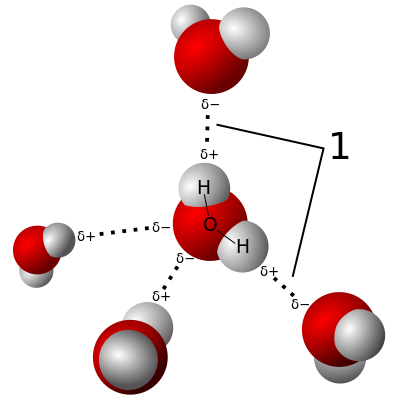
Just in case you never received basic science education.
Okay, so water is really, really, important to your well-being aside from your survival. You get that. Maybe you've even experienced moderate dehydration from a nasty hangover and you already get the point. But here's the thing: most people don't drink enough water and as a result are dehydrated without even knowing it.
Sure, you can get through your day just fine being a little dehydrated. But it's simply suboptimal. Being a tiny bit dehydrated is almost undetectable in terms of thirst, but mood and energy will usually suffer, and it would even be obvious that your symptoms will be from dehydration. It will usually feel like you're having a crappy day. It is a really good idea to keep a water bottle with you most of the time to make it easier to stay hydrated. I carry around a metal bottle with a cap that pops open with the push of a button; some people prefer Nalgenes (or, you could get the best of both worlds).
I'm not a fan of disposable water bottles. Sure, there's the whole wasteful aspect of it (I'm no hippie but it's appalling), but bottled water is stupidly expensive. I never buy bottled water. Unless you're a water snob (you'd better not be buying the stuff from the municipal supply), I suggest you drink tap water (you can filter it if you want). However, if the thought of drinking tap is just too much for you to handle, do yourself a favor and get tea (green tea is good) or something else instead-- at least you won't be ripped off.
I don't always buy bottled drinks, but when I do...
Exercise is great because it makes you much more aware of otherwise undetectable levels of dehydration. You often end up drinking more water than you sweat and breathe out, which is a contributing factor to exercise making you feel better.
However, there's another side to this that I have experienced all too often: sometimes I'll drag myself to the gym feeling lethargic and tired, even if I am relatively well-rested and well-sustained by food, and it's mostly a mystery as to why I feel so incredibly weak; it's a physical state as well as a mental one that I just can't work though. Perhaps you have experienced it too, and as you may have already guessed, this is another case of mild dehydration. Remember, thirst is not the only symptom of dehydration.
Drink your hypotonic fluids, people; you'll be glad you did.
I'm going to say it right now: the majority of personal trainers suck at their jobs. The ones that don't are usually expensive. If you're a personal trainer and reading this, I'm not attacking you; I'm speaking in generality here. Of course there are plenty of good ones, but statistically speaking they are in the minority.
Certifications of personal trainers are mostly arbitrary, like a college degree is to a Starbucks barista. Just because you have a fancy piece of paper, it doesn't automatically make you special. Heck, I just saw an ad for this certification that can be done completely online.
However, real certifications, especially anything geared toward strength or conditioning or athletic performance, such as the CSCS certification, are very good. There are several good undergraduate degrees that can get people started in the right direction as well.
I should know because I've had a personal trainer in the past; turns out that he didn't really know what he was doing. He was a good guy and all, fun to be around while working out, but didn't exactly get the job done after the first couple of months. And it wasn't just him. I know people who have employed the help of trainers and gotten much less than their money's worth. And I see trainers having their clients do the stupidest stuff sometimes.
LOL.
Now, that's not to give trainers a bad rap. There are plenty of good ones out there, and even the mediocre ones can be worth it in the short term. My trainer put a good bit of muscle on me in the first couple of months, simply because I started lifting weights on a regular basis and ate a lot more protein. It worked for a while, until my body adapted. I ended up on a plateau that lasted for the last several months I was with him. Sure, it was hard work all the way through, but you have to train smart, and not just hard, if you want continued progress.
Then I went to college and trained the same way I was taught, because that was all I knew. I also decided that I plateaued earlier because I wasn't eating enough, so I fixed that.
It didn't work.
The next semester, I stopped kidding myself. It was obvious that what I did in the Fall was a complete failure. I was not happy with the way I looked. I needed to do something new.
So I did P90X. And I got some pretty decent results. And I realized that I had wasted so much time and effort in the months before.
But that was OK, because I was finally moving forward again.
And that was the beginning of what led me to learn a lot of things through research and real-life experience, and eventually start this blog.
Currently, I'm halfway training, halfway working out with a friend of mine. I am sure I will get some good results out of him because, unlike most personal trainers, I am continually learning more and more about fitness and nutrition, and a lot of times the hard way. Plus it makes going to the gym more enjoyable for both of us.
In the end, most trainers that are subpar tend to overcomplicate things. As a rule of thumb, if a trainer has clients use the swiss ball a lot, he or she doesn't know what the hell they are doing.
A lot of topics in this post are complementaryto (and some unavoidably redundant with) my post On Weight Loss in general. This is more geared for troubles you may encounter while doing so, and what you can do about it.
A common problem
For most of us normal people, energy is not something that comes by easily. A lot of the time, it's what prevents people from working out in the first place because day-to-day life is draining enough.
I've been in that situation many times; I usually fall off the proverbial horse at the waning time of each semester, and
just not having enough energy to exercise on a regular basis, so some knowledge in this post is stuff I learned the hard way.
I'm a pretty low-energy person most of the time. I'm very susceptible to "the blahs." I believe I have a naturally subpar metabolism, and as a result I'm a bit more lethargic and lazy than the average person. If you're like that too, I hope some helpful things from this post that I figured out the hard way.
Energy and metabolism go hand-in-hand. A higher metabolism means your body uses more energy, and therefore makes you more energetic. That explains why most naturally lean people seem to never run out of juice, and it seems a bit unfair at first considering that the ones who really need that energy are the ones who aren't naturally thin or athletic. However, there is good news: our metabolisms are not set, and fortunately we can do a few things to fire them up.
Sleep
I'm a night owl but I love to sleep. I'm definitely not a morning person; it takes forever to get going in the morning, and I will sleep 10 or 11 hours a night if I don't set an alarm.
Sleep is a huge factor in regulating energy levels. Not only does it need to be sufficient (it varies individually; some people only need 8 hours or less), but also somewhat consistent. This has a lot to do with hormones. When things get out of whack, your body will do what it can to fix that, usually by making you tired all the time.
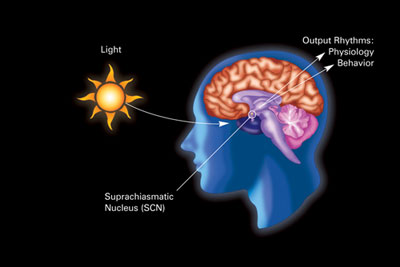
Artificial light can really confuse your brain. So can a timezone shift. Ever had jet lag?
When I "fell off" the horse so to speak near the end of the semester, my sleep schedule and biorhythms were FUBAR. Some days I had 8 AM classes, and on others my day started at noon. I ended up staying up late all the time but taking naps on a regular basis; I discovered later that these long naps were ultimately not helping to regulate my hormones (the all-nighters didn't help, either). Power naps (< 30 minutes) are usually great because it gives you a boost of energy to help you take on the rest of the day without sending you into deep sleep and subsequently messing up your hormonal cycle.
Stress (the hormone cortisol) can be a real problem if it gets out of control. Having a regular and adequate sleep schedule can do very well to prevent this from happening, because cortisol is a really bad thing to have too much of. If you have chronically high levels of it, it can do a bunch of things to make you feel bad and kill your metabolism.
Nap minimally and sleep at fairly regular hours if you want to work with, rather than against, your hormones. To facilitate this goal, keep artificial light to a minimum when it gets late. It is worth noting, though, that getting in shape will often improve chronic medical conditions of all kinds.
Exercise
The ironic thing about exercise is that it actually increases your metabolism by a substantial amount for at least a day, but people (including myself) will still avoid it if they don't feel they have enough gas in the tank to do so. This explains, in part, the phenomena of getting on "the horse" or "the wagon."
Or, you can doboth!
The degree of metabolism boost varies with type and intensity of exercise, but generally anaerobic (e.g., weightlifting) activity is much more effective than aerobic (e.g., plain cardio) exercise. This is tied to the fact that anaerobic exercise is superior for weight loss; a higher metabolism means more fat can be burned for energy. I've talked about this in detail in my past posts.
Food AND Exercise are crucial to success
Food is energy. It shouldn't surprise you that if you don't eat enough and don't exercise, your energy levels will drop. Your body likes to conserve energy, because it's a survival mechanism: eat less, burn less. It's quite good at conserving energy when there is a scarcity of food. "Calories in - Calories = Calories Lost/Gained" out is still valid (thanks to thermodynamics), but Calories out is a function of Calories in, among many other things. This is why dieting without exercise isn't very effective most of the
time, and why "weight loss calculators" based on calorie intake almost never work. The energy balance becomes useless for calculations when you can't easily determine Calories out. Your body doesn't care that you want to lose weight; it just does its thing and isn't going to burn fat unless it has to. So if you diet and don't exercise, your metabolism will slow down. And when that happens, your energy levels will drop, you may feel like crap, and eventually it will get to the point where you won't have the energy to exercise, and your diet will ultimately "fail."
Fortunately, exercise will force your body to pump up your metabolism in spite of low energy intake from food. This is why both diet and exercise are needed for substantial fat loss.
On the flipside, too much exercise and not enough food will cause you to "burn out." Eating very few calories is not really "dangerous" but your body can only surrender so much fat in a day. When the caloric deficit becomes too large, your body will slow down and your energy will drop.
Consistency is key. I've said it before and I'll say it again: Livestrong.com's MyPlate is an excellent food tracker that I HIGHLY RECOMMEND if you're having trouble losing weight, or want to do things right the first time. If you're doing some form of exercise but not making progress, chances are that your diet needs work. Don't forget that protein is #1. Sometimes, meat is better than fruits or veggies as far as looking better is concerned.
Stimulants
So, let's say you're doing everything right, but you just don't have the drive to work out. If all else fails, stimulants are a surefire way to increase your energy and/or metabolism. Some people need them all the time; others just need it as an occasional boost.
Stimulants in a nutshell.
Of course there's the #1 drug in the world, caffeine, that some people depend on almost every day to get their day started. Sometimes, that's all it takes, but there's always more out there if it's not good enough for you.
As a lazy college student, I don't even bother:
200 mg pills are not recommended on an empty stomach.
Weight-loss supplements work by either increasing metabolic levels (Calories out), giving you enough energy to work out, or both. Some are better than others, and some (usually the overpriced ones that are advertised with outrageous claims) are crap. Some "pre-workout" stimulants (e.g., Jack3d, which I love) are great for shifting your metabolism into turbo mode; they do double-duty by making your workout more productive, and boosting your metabolism in general. The fat-loss stimulants which make a substantial difference are inevitably very powerful, and erroneously seen as dangerous in most cases. The infamous ephredrine was banned because it was effective and subsequently abused once it became popular; not because there is something inherently dangerous about it.
There are some other mental hacks you can do that help you to make exercise not a drudgingly painful experience; I'll talk about that and some relevant psychology in an upcoming post.
TL;DR
The key to energy and subsequently improving your body? Get your sleep, balance your food and exercise, and take stimulants if you need or want an extra boost.
If you're like me, you're not one of those naturally skinny people who can get away with eating whatever they want. While it's true that these people are genetically gifted with hyperactive thyroids, and it seems unfair to the rest of us 'normal' folk, way too many people take it the completely wrong way and figure that because they're genetically 'inferior,' it's not even worth the effort fighting DNA destiny.
To be clear, virtually no one is 'genetically fat.' Metabolic rates may vary a lot between individuals, but that really shouldn't matter as far as goals go. 'Predisposed' fat people just don't need that much food to subsist. What gets them there is when they eat the same as everyone else (or more, of course)-- living in a sedentary giant-portions culture doesn't help. So 'naturally' fat people are so just because it's easier for them to get that way, not because they are doomed to that existence.There is nothing keeping a 'genetically fat' person from achieving the body of a Greek god, or making that goal overly difficult.
Yes, I did recycle this picture-- it's so apt.
However, a lot of overweight people aren't that way just because of their hypoactive metabolisms; some simply put way too much coal into the furnace, but I believe most are victims of the high-carb and high-fat (yes, they're terrible together) modern diet.That's compounded when carbophiles become insulin resistant.
Crossfit. Chances are, you've seen some commercial or t-shirt or someone mentioning it on a social media site. It has become some sort of weird phenomenon in American fitness culture.
Personally, I hate it. Well, maybe 'hate' is too strong of a word. I strongly dislike it, and I'll show you why.
Firstly, it's a cult. Yeah, you read that right-- a fitness cult. Men's Health thinks so. Heck, crossfit even admitted it themselves. It's a widespread organization that tends to suck people in. It brainwashes them (no, seriously) to a certain extent and makes them blind to everything else. What do I mean by that? Well, first off, crossfitters think of themselves as totally awesome and the rest of the world sees them as insane. It turns people into sadists. The workouts are ludicrous and they love it. I remember a while back seeing someone on Facebook who used "puked" and ":D" in the same sentence.
Why it's retarded
People actually pay lots of money to do something in a group setting they could do on their own. Like, $100/month minimum, on top of gym dues (if applicable).
"Forging elite fitness" is their slogan (which is parodied in this blog). They consider themselves elite "athletes," when, in fact, their haphazard and unfocused crazy workouts leave them as jacks of all trades, and masters of none.
Most crossfit locations follow a "Workout of the Day," or WOD. It's typically a random combination of at least 3 stations, it has a rigid structire, and is done for time. Everyone does the same exact damn thing, regardless of skill level. As if that wasn't bad enough, good form is not emphasized, which is just begging for injury.
And then there are the kipping pullups.
Kipping (exploiting momentum to get one's body up the bar) pullups have a special place in crossfit hate, for obvious reasons. A kipping pullup might as well be called a "cheating" pullup, because all it does is enable you to do an arbitrarily large number of the exercise with ZERO practicality. YouTube videos of the exercise have incredibly low ratings-- and just look at the comments.
What it will do is get you into shape, and it does tend to make people look good, though it's definitely one of the most painful paths to accomplish this. Sometimes it goes too far with women's bodies, though.
Crossfit can show you your limits, and make them grow. Self-discipline and tenacity carries over to the real world. It teaches you how to overcome mental barriers, and if you're not a self-motivating type, it can show you how easy
your "workouts" are in comparison. Good stuff can come out of pushing
yourself so hard, as long as it doesn't burn you out (which is ultimately inevitable, anyway). Building character and what doesn't kill you and all that.
Chances are, you've heard of P90X, the most popular DVD workout
program ever produced. It's commonly featured in late-night
infomercials, and knowledge of it has spread to many by word of mouth.
As the name implies, it's a 90-day program designed to whip you into
shape, and it works. It was produced by a company called Beachbody and it is led by none other than Tony Horton.
Tony Horton. Richard Simmons, eat your heart out.
P90X is not for everyone, though-- those who are too out of shape will
find that they won't be able to keep up. For these people, P90, the less-extreme
predecessor of P90X, would be a better choice, along with several other programs that Beachbody has to offer. For extremely out of shape people, you can never go wrong with the classic tried-and-true weight-loss program: diet and walking (or even jogging).
The Right Stuff
Tony
Horton is extremely encouraging and does not fail to motivate you. He's
ridiculously full of energy and gets you excited about the program,
especially from the start. That builds momentum and makes it easier to
stick to the program even if the workouts are not easy. Somehow, Tony
manages to make those as fun and entertaining as theoretically possible
while still kicking your butt. He nudges you out of your comfort zone
without you realizing it a lot of the time.
Tony is very spontaneous.
The
difficulty level seems to be just about right. Most workouts are intense
enough to be productive and efficient, but the nature and pace of the
workouts makes them very flexible and allows the user to adapt according
to his/her own skill level. What do I mean by that, exactly? Time
management.
As far as the regular resistance-based
workouts go, a lot of the exercises are done on a time basis. You do
what you can, and often there's time left over for you to catch your
breath before the next movement. This works great because those who are
in not-so-good shape are weaker, thereby finishing sooner because they
cannot do as many reps, allowing them more time to rest. When an
exercise is based on the 8-12 rep scheme, it still works well for the
newbies because less resistance or weight means a smaller cardiovascular
demand.
The program goes with you; once you get over
that initial adaptation phase, each workout pretty much has its own
difficulty level that stays constant. The ability to do more reps or
more weight puts a greater cardiovascular demand on you, so you progress with the program and it doesn't get much easier or harder.
Eventually, you too can master levitation.
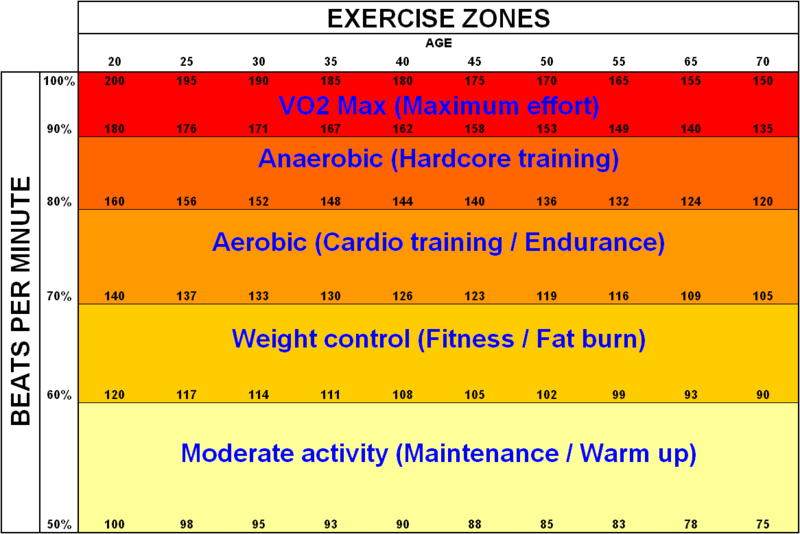
This goes for the hardest video, Plyo X, as well. Tony puts emphasis on pressing pause and taking a break if you need it onall the videos, but this advice is especially pertinent for this one. The plyometic workout is hard. It never gets easy. It pushes your limits. Tony Horton recommends a heart rate monitor. When I'm in the middle of a cycle and not taking a break (There were less than 5 times when I got through the whole thing without hitting pause) my heart rate tends to be in the range of 160-180 BPM. The upper limit of 180 and into 190 territory is a ridiculous amount of exertion. I've broken 200 BPM on rare occasions-- that is almost literally maximum effort.
Plyo X: Hardcore training. Also, the "weight control" range is BS; it's arbitrarily named.
On difficulty
P90X is tough, especially "the X in P90X," Plyo. However, there comes a point where workout difficulty becomes more self-torture than simply a physical challenge. I am not an advocate of exercise that is this intense. I am not masochistic; I believe that difficulty has a place, but sustainability is much more important. Exercise should not be unenjoyable to the point of suffering.
P90X works very well because it mostly follows the general structure of HIIT (High Intensity Interval Training) and resistance circuit training. These are extremely effective ways to lose body fat, and they also happen to be very good for building muscle on new trainees. This often results in a recomposition of body mass, which is often termed as the "transformation" that is so heavily lauded in the advertisements.
The program has a great amount of variety with over 10 different workouts, some of which are very unique. The 90 days is split into 3 three-week phases with a "rest week" after each phase.
However, "rest weeks" are mostly "let's do something different" weeks
instead of actually taking it easy during that time.
Not
all videos were created equal. Some are easy, some are hard, one in
particular is hard in another way: yoga. At an hour and a half long,
this workout made me run out of patience after a few weeks, in spite of Tony's assertions that it is worth it. But it is great for developing flexibility and non-traditional strength; it is an aspect of fitness that should be appreciated, though some people take yoga too far and use it as their primary form of exercise, thereby neglecting more important things.
Trust me, this is harder than it looks.
Learning by Doing
There are a lot of educational and psychological benefits to P90X, which are just as good as the physical changes that the program makes, if not better. The program is great for introducing the uninitiated and the directionless into having a solid fitness regimen.
The nutrition plan helps to change your perspective on eating and food if you've never followed a real diet before.
It pulls you away from the common misconception that "cardio" on a machine or otherwise is all you need to lose weight.
It teaches you the correct way to lift weights, and shows women that resistance exercise should not be avoided.
It demonstrates that you don't need a gym to get in shape.
It emphasizes flexibility, something that is often overlooked.
It proves that you can change your body for the better if you want to.
It builds character, to some extent
It improves discipline and self-control
It toughens you up
Etc.
The program is great for building mental endurance and toughness. It teaches you how to "bring it"-- to transcend mental blocks and give a serious effort, focusing on the task rather than your comfort. It teaches you how to set a goal and achieve it. And it does all this without being too difficult.
P90X does not require you to be this intense and inspiring.
Words of Wisdom
Sorry for being cliché, but the journey is more important than the destination. The journey never ends; those who reach their goals and fall back to their old ways are defeating the point. I don't like saying "fitness is a way of life" because that sounds a little too serious. Rather, it's more of a hobby. A hobby does not control your life-- it's something you do. If you want to live longer and look and feel better than everyone else your age as you get older, you're going to need to be active. But that doesn't mean you have to do P90X, or try to look like a fitness model.
Problems with the Program
The
nutritional plan is fairly decent. It's outdated and not very flexible,
but it works for the most part. It throws around some broscience (workout/gym "bro" + pseudoscience; false assertions made by those who look good but don't necessarily know what they're doing) which
is harmless on its own aside from spreading falsehoods and ignorance.
Some of its marketing is misleading, specifically the term "muscle confusion" which is a load of pseudoscientific crap:
Broscience and steroids. I'm dead serious on the steroids accusation-- the results on this guy were not remotely possible without them.
The program is great for getting into better cardiovascular shape and losing body fat. It is not very good for building muscle, unless the user is fairly new to resistance training. However, it does improve muscle conditioning and endurance, and even strength in certain metrics.
Also, it includes static stretching before certain workouts, which turns out to do nothing but weaken your muscles. Dynamic stretching is much better for warming up, and static stretching should be reserved for afterwards.
While most of the equipment for the program is easily justifiable, for-profit Beachbody tries to make as much money off of you as possible. The "recovery drink" mix is mentioned a lot, and is really not much more than powdered protein and sugar that is ridiculously overpriced. The equipment you do need often costs a good bit more from Beachbody than elsewhere. But I guess that's just capitalism at work.
My whole story is somewhat long, so I'll try to not start too far back. When I came
to college, I stuck with mindset my trainer gave me, but decided all I needed to do to gain muscle was to eat more. In the end, I ate lots, gained
minimal muscle, and got fatter. Next semester I decided I needed some
serious change and committed to doing P90X. I ate a lot less food and worked hard, and started seeing progress pretty quickly. So without further ado, here are my before and after pictures: